What actually makes an AI business a real business
The problem with almost all content about making money with AI is that it promises you will get rich doing things anyone could do: restoring old photos, removing backgrounds, writing generic text. That is not a business, it is something your client can do themselves, for free, in ten seconds, the moment they find out the tool exists.
A real business is one where the client cannot do it themselves even if they wanted to. Here are six AI businesses where that actually holds true, with the real rates being charged right now. The first one you can set up this very afternoon, and the last one has the best revenue model on the whole list.
Business 1: video ads for small businesses
Let us start with the one that can pay off fastest, since it has the lowest technical barrier of the six.
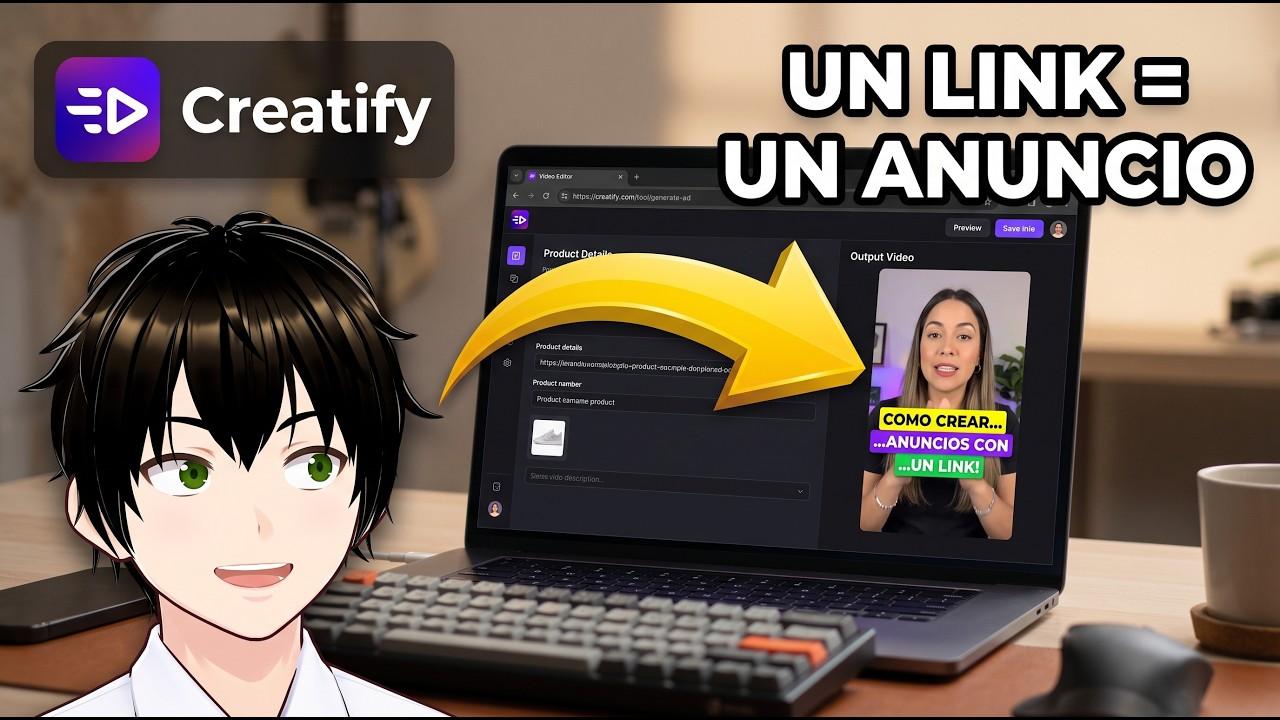
There is a tool called Creatify where you paste in a product link and, within a couple of minutes, it hands you back a finished video ad: an avatar talking to camera, an optimized script, exported in the formats you need for TikTok, Reels, or YouTube.
It is not just another tool out of the thousands launching every week. Its engine is trained on more than fifteen million ads and over a billion dollars of analyzed ad spend, so it does not generate the video it thinks looks nice, it generates the type of ad that statistically performs.
Where is the business here? Think of a small store, online or physical, in your city. They know they should have video ads, but shooting a real one costs hundreds of euros between the actor, camera, and editing, and they cannot afford it. You deliver five ads for five products in one afternoon.
And even if that business knew about the tool, they are not going to set up a subscription, learn to use it, and test until they land on something they like. You are not selling them the button: you are selling them the finished, already-chosen result.
The trick to making it work long-term
Do not sell one-off ads, sell monthly retainers: for example, ten ads a month for a fixed fee. In advertising, the winner is not the one who makes one perfect ad, it is the one who tests twenty and keeps the one that works. Until now that was too expensive for a small business; you make it possible for them.
Business 2: license your voice
This is the only business on the list where you do the work once and get paid forever.
ElevenLabs has a marketplace where you upload a clone of your voice, and every time someone in the world generates audio with it, you get paid. The platform has already paid out more than 22 million dollars for this, and more than 10,000 people are earning from it right now.
There are no clients to find, no deliveries to make, nothing to maintain. And most voices in the catalog are in English, so as a native Spanish speaker you are entering a market with far less competition.
Set it up this very week while you learn the businesses that follow, which do take more time.
Business 3: automate a company's processes
And now we get into the real businesses, the ones with a genuine barrier to entry. Let us start with the one most people are monetizing right now in Spain and Latin America.
It consists of taking a company's repetitive processes and making them happen automatically. For example: orders that arrive by email get read, validated against stock, and logged without anyone touching them. Or leads that come in through the website get classified and prioritized automatically. Or weekly reports get generated and sent on their own. Or support tickets get classified and routed to the right department.
This is why freelancers are charging between 30 and 50 dollars per project, rising to 50-90 dollars with experience.
Why can the client not do it themselves? Because it is an exhausting process they cannot afford to take on: someone has to sit down with them, see how they actually work, figure out what can and cannot be automated, and build the flow accounting for every edge case and every possible error.
The go-to tool for this is n8n, and 84% of companies still have not redesigned their processes to integrate AI, so there is still plenty of market left to cover.
Business 4: the assistant that knows your company inside out (RAG)
Business four, and this is the one most people mistake for something simple when it is not.
Anyone can open ChatGPT and ask it questions. What nobody can do on their own is build an assistant that knows their company's internal documentation inside out: the full product catalog with prices and stock, technical manuals, warranty terms, internal procedures.
That is called RAG (retrieval-augmented generation), and it means giving the AI access to the company's real documentation so it answers using its own data instead of generic information from the internet. That is the difference between a toy and a product: a generic chatbot answers anything; this one answers that product X is priced at an exact amount and how many units are left.
Why can the client not build this alone? Because there is real technical work behind it: processing and chunking their documents, building the database that indexes them, connecting it to their systems, and above all, verifying that it does not make up answers — which is the hardest part, and the one that separates a professional from someone who watched a tutorial.
It is a service that sells very well to companies with lots of documentation and lots of repetitive support: distributors, technical companies, academies, or anyone whose team spends all day answering the same twenty questions.
Business 5: micro-SaaS with AI
Business five, and here the model changes completely: instead of selling your time to clients, you build a product that sells itself while you sleep.
A micro-SaaS is a small tool that solves one very specific problem for one very specific niche, paid for with a monthly fee. AI has made possible something that was unthinkable three years ago: a single person building and maintaining a product like this.
And here is the key almost nobody understands: the value is not in the AI model itself, which is the same one anyone can use. The value is in the wrapper: having understood the problem of a specific trade, having built the exact flow it needs, and having packaged it into a single button. The plumber does not want to learn how to prompt an AI: they want their quote generated automatically.
Think about boring niches, because that is where the money is: accounting firms, academies, clinics, repair shops, small real estate agencies. The more boring and specific, the less competition and the more willing the client is to pay. For example, an AI that transcribes what your local mechanic says while giving a quote and turns it into a more professional message. Or an AI for an English academy that, with one click, generates a worksheet for whatever unit the students are currently on.
The barrier here is that you need to know how to build it, or learn to, and you need to provide support. But in exchange you get the one thing that truly scales: recurring revenue that does not depend on your hours.
Business 6: the voice agent that answers the phone
And we reach number six, the one with the best sales pitch out there right now.
It consists of building an AI voice agent that answers a business's phone: it picks up the call, understands what the caller needs, responds with the business's real information, and books the appointment directly on its calendar.
And the numbers sell themselves. Running one of these agents costs between 12 and 30 euro cents per minute, all included. An outsourced call center costs between 70 cents and 1.30 euros per minute: three to six times more.
But the number that closes the sale is this: a receptionist in Spain costs on average about 19,400 euros gross per year, and covers roughly 24% of the hours in a week. The agent covers 100%, never takes a day off, never gets sick, and handles several calls at once with no extra cost per line.
What does building this actually involve? Quite a bit more than it sounds: training the agent on the business's real information, integrating it with their calendar and CRM so appointments land where they should, tuning the latency so there are no awkward silences, configuring what happens when someone asks something off-script, and deciding when to hand the call off to a human. None of that gets solved with a ten-minute tutorial.
The pricing model is the best on the whole list, because it has three legs: you charge for the implementation once, a monthly maintenance fee, and per-minute usage. Every client you close leaves you with recurring revenue, not a one-off payment.
Who do you sell it to? Dental clinics, repair shops, hair salons, accounting firms, restaurants... any business that loses calls outside business hours or while they are already on another line. Do not sell them technology, sell them the calls they are losing every week, because that is what actually hurts. To make the agent sound professional, ElevenLabs has thousands of different voices to choose from.
Which one to choose based on your situation
All six businesses share something in common: in every one of them, the client knows they need the solution, but cannot build it themselves even if they wanted to, even knowing the underlying tool exists. That is exactly where the margin is.
If you want to start today with almost no technical barrier, video ads and voice licensing are the entry point. If you have a bit more time and want to build something with a real barrier to entry, process automation and RAG assistants are what is being monetized the most right now. And if you are after the strongest long-term revenue model, micro-SaaS and voice agents are the ones that leave you with genuine recurring income.
You have the full breakdown of Creatify and ElevenLabs, with real rates and screenshots, in the guides on Creatify: creating ads with AI and making money with ElevenLabs. And you have the rest of the tools and platforms we verify in our complete directory.